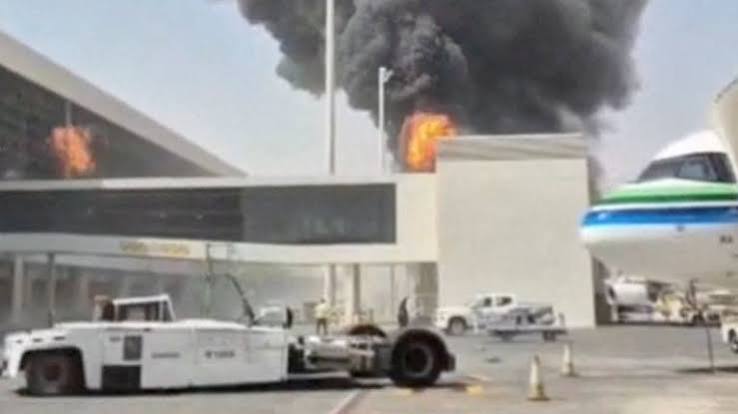
The latest attack on the international airport in Saudi Arabia’s capital of Riyadh killed 12 people and injured over 300 others, civil aviation authorities said early Sunday, with some in critical condition. A Saudi-led coalition blamed Iran-backed Houthi rebelsin neighboring Yemen. It was the deadliest attack in any Gulf Arab country since the start of the Iran war, whose fronts have expanded to include the recent surge in fighting between the Houthis and Saudi-backed Yemeni government forces.
The attack — the latest of several in the past week on the airport — is expected to increase Saudi pressure on allies including the United States to provide military support for the kingdom, which has seemingly tried to avoid all-out war with the Houthis.
Shortly after the attack on Saturday afternoon, President Donald Trump said he was evaluating whether the U.S. should join Saudi strikes against the rebels. “We may. We’re going to look at it,” he said. “We just found out about the recent attack. So we’ll make a decision. We move very quickly.”
The Saudi-led coalition fighting the Houthis blamed them for the attack, calling it a “fully-fledged war crime” and vowing a firm response. The airport has no military facilities.
There was no immediate statement from the rebels, who earlier Saturday accused Saudi Arabia of striking Sanaa International Airport in the Houthi-held Yemeni capital.
Saudi civil aviation authorities earlier Saturday said airport operations were suspended. The airport had a heavy police presence, with all entrances blocked, and lights around the complex were dimmed. Flights diverted elsewhere, the Flightradar24 tracker said. Countries including the United States, Britain, Germany, Australia and Canada warned citizens to avoid the airport.
Saudi Arabia is running low on missile interceptors and has asked France, Britain, Pakistan and Egypt to deploy air defense support to the region, regional officials said last month, with one noting that the U.S. has seen its own stock dwindle during the war with Iran.
Officials have said U.S. assistance has included intelligence sharing, target identification and planning for the latest offensive against the Houthis.
On Saturday, Saudi Arabia said its foreign minister and Omani counterpart spoke by phone about the importance of “supporting diplomatic solutions to de-escalate tensions” in the region. Oman, which lies across the Strait of Hormuz from Iran, has played a mediator role at times in the region.